How to Choose the Right Automotive Filter
Learn the key factors to consider when selecting air, oil, fuel and cabin filters for different vehicles and applications.
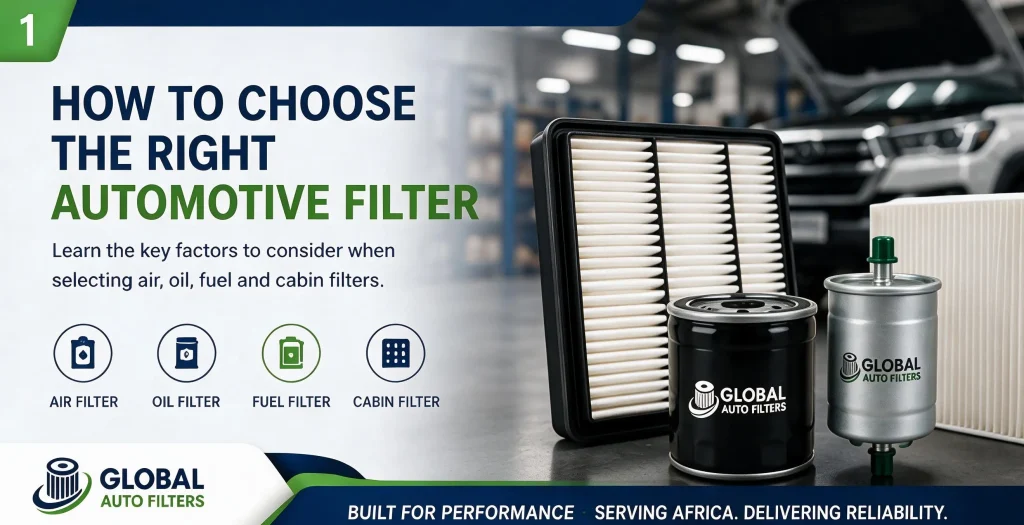
Choosing the right automotive filter is important for vehicle performance, engine protection and maintenance efficiency. However, selecting a filter is not simply a matter of choosing one that looks similar to the original part.
Different vehicles require different filter specifications. Engine type, vehicle model, production year, application, operating environment and filter dimensions can all affect compatibility.
For distributors, wholesalers, spare parts retailers, workshops and automotive businesses, accurate filter identification is especially important. A wrong filter can lead to installation problems, poor filtration or unnecessary returns.
This guide explains how to choose the right automotive filter, how to use OEM and part numbers, how to identify the four main types of automotive filters, and what buyers should check before placing a wholesale order.
What Is an Automotive Filter?
An automotive filter is a component designed to remove unwanted particles, contaminants or impurities from air, oil, fuel or the passenger compartment.
Most vehicles use several different types of filters, with each one serving a specific function.
The four common automotive filter categories are:
- Air Filters
- Oil Filters
- Fuel Filters
- Cabin Filters
Although all four are filtration products, they are not interchangeable.
Each filter has a different construction, filtration media, size and application.
For example, an engine air filter is designed to clean the air entering the engine, while an oil filter removes contaminants from engine oil. A cabin filter serves a different purpose by filtering air entering the vehicle interior.
Understanding the application is the first step toward selecting the correct filter.
Why Choosing the Right Automotive Filter Matters
A filter may appear to be a relatively simple replacement part, but its specifications can have a direct impact on vehicle operation.
The correct filter should match the vehicle application and meet the required dimensions and filtration requirements.
The main reasons accurate filter selection matters include:
1. Proper fitment
The filter must physically fit the designated housing or installation position.
2. Effective filtration
The filter needs to provide suitable filtration for its intended application.
3. Vehicle compatibility
Different engines and vehicle configurations may use different filter designs.
4. Maintenance efficiency
Correct filter identification reduces installation problems and unnecessary replacement work.
5. Reduced returns
For wholesalers and distributors, accurate part matching can reduce incorrect orders and product returns.
6. Better customer service
Providing the correct filter helps retailers, workshops and end users receive a more reliable replacement solution.
For B2B buyers, correct identification is therefore both a technical issue and a purchasing issue.
The Four Main Types of Automotive Filters
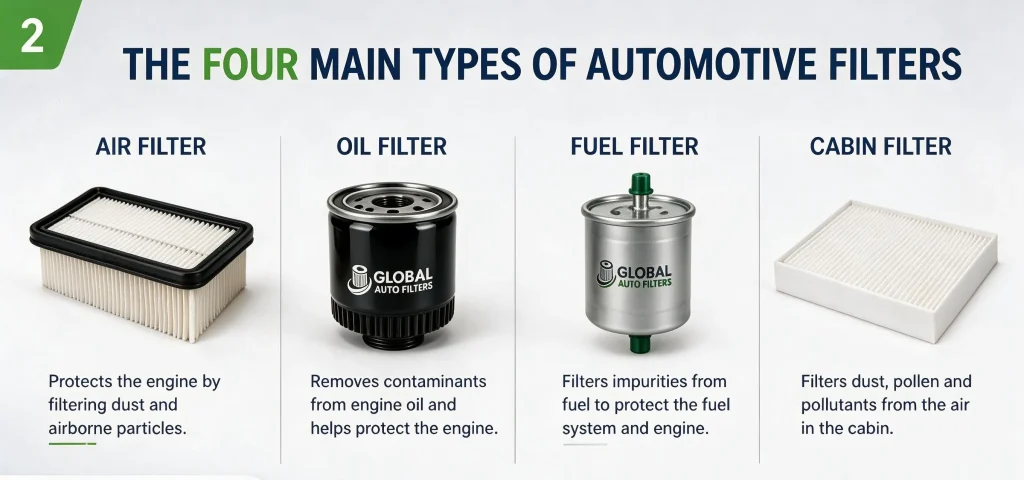
Before selecting a filter, identify which filtration system you are dealing with.
1. Air Filter
The engine air filter removes dust, dirt and other airborne particles before air enters the engine.
A clean and properly fitted air filter helps maintain the intended air intake system performance.
Air filters are commonly available in different shapes and constructions, including:
- Panel air filters
- Cylindrical air filters
- Round air filters
- Heavy-duty air filters
- Commercial vehicle air filters
Air filter applications vary significantly between passenger cars, SUVs, pickups, vans, trucks and other vehicles.
When choosing an air filter, check:
- Vehicle make
- Vehicle model
- Engine type
- Production year
- Filter dimensions
- Housing design
- OEM number
- Existing filter reference
A filter with similar dimensions is not necessarily the correct replacement.
2. Oil Filter
The oil filter is designed to remove contaminants from engine oil.
Engine oil circulates through the lubrication system, and the filter helps capture unwanted particles generated or introduced during operation.
Common oil filter designs include:
- Spin-on oil filters
- Cartridge oil filters
- Element oil filters
The correct oil filter depends on the engine and vehicle application.
Important oil filter specifications may include:
- Thread size
- Gasket dimensions
- Filter diameter
- Filter height
- Valve configuration
- Housing design
- OEM reference
- Application
When purchasing oil filters in bulk, relying only on product appearance can create compatibility problems.
The safest approach is to verify the application or cross-reference the original filter number.
3. Fuel Filter
Fuel filters help remove contaminants from fuel before it reaches sensitive components of the fuel system.
Fuel filtration requirements can vary depending on the vehicle, fuel system and engine configuration.
Diesel vehicles may have particularly important fuel filtration requirements because contamination and water in fuel can affect fuel system components.
Fuel filters may include different designs such as:
- Inline fuel filters
- Spin-on fuel filters
- Cartridge fuel filters
- Fuel filter assemblies
Check these details before selecting a fuel filter:
- Fuel type
- Vehicle application
- Engine model
- OEM number
- Part number
- Connection type
- Dimensions
- Filter configuration
For commercial vehicles and diesel applications, application accuracy should receive particular attention.
4. Cabin Filter
Cabin filters are designed to filter air entering the vehicle passenger compartment.
They can help reduce dust, pollen and other airborne particles entering through the vehicle ventilation system.
Depending on the vehicle and filter specification, cabin filters may use different types of media.
Common examples include:
- Standard particulate cabin filters
- Activated carbon cabin filters
- Multi-layer cabin filters
When selecting a cabin filter, physical dimensions are important, but dimensions alone should not be the only identification method.
The correct vehicle application and part number should also be verified.
The Most Important Factors When Choosing an Automotive Filter
Selecting the correct automotive filter requires more than checking the product name.
The following factors should be considered before ordering.
1. Vehicle Make
Start with the vehicle manufacturer.
Examples include:
- Toyota
- Ford
- Volkswagen
- Hyundai
- Kia
- Mercedes-Benz
- Isuzu
- Mitsubishi
The same filter type can have completely different applications between manufacturers.
Therefore, always start with the vehicle make before checking the specific filter.
2. Vehicle Model
The vehicle model provides another important level of application information.
For example, a manufacturer may produce several different vehicle models using different engines and filter configurations.
A Toyota vehicle, for example, does not automatically use the same filter across all models.
Therefore, the basic application information should normally include:
Make → Model → Year → Engine
This creates a more accurate starting point for filter identification.
3. Engine Type
Engine specifications can be one of the most important factors when selecting an automotive filter.
The same vehicle model may be available with:
- Different engine sizes
- Petrol engines
- Diesel engines
- Different engine generations
- Different power outputs
- Different fuel systems
As a result, two vehicles with the same model name may require different filters.
For B2B sourcing, engine information is particularly useful when a vehicle has multiple configurations.
4. Production Year
Vehicle specifications can change during a model’s production cycle.
A filter used on an earlier version of a vehicle may not necessarily fit a later version.
When possible, confirm:
- Model year
- Production period
- Engine generation
- Facelift or model revision
Production year should be used together with vehicle model and engine information rather than as a standalone identification method.
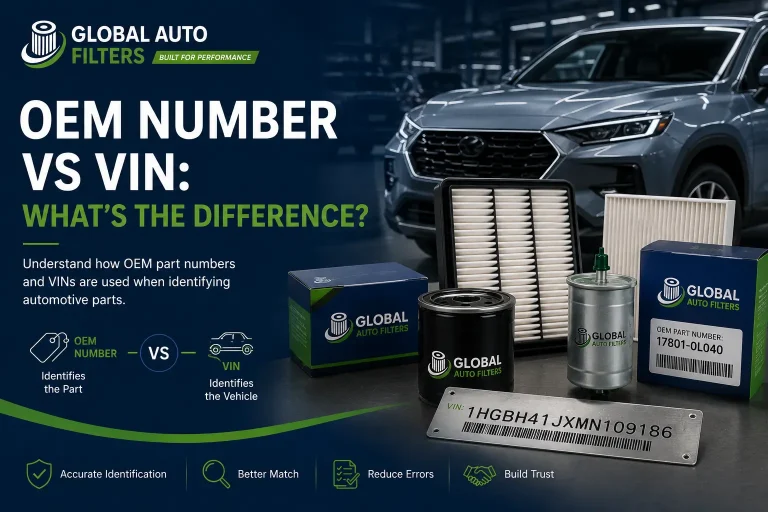
5. OEM Number
The OEM number is one of the most useful references when identifying an automotive filter.
OEM numbers are associated with original equipment applications and can provide a much more precise reference than a general product description.
For example, instead of asking only for:
Toyota oil filter
a buyer can provide:
OEM number + vehicle model + engine
This gives a supplier a stronger basis for cross-reference.
Why OEM numbers are useful
They can help buyers:
- Identify the original application
- Cross-reference aftermarket products
- Reduce incorrect orders
- Compare equivalent filter references
- Communicate specifications with suppliers
However, OEM numbers should still be verified because numbering systems and application ranges can vary.
6. Part Number
An aftermarket part number is another valuable identification reference.
If a customer already has an existing filter, the number printed on the filter can often be used as a starting point for replacement sourcing.
A buyer may provide:
- Existing filter brand
- Existing part number
- OEM reference
- Filter photos
- Vehicle information
This information can then be used for cross-reference and application verification.
7. Filter Dimensions
Dimensions are useful when identifying a replacement filter.
Depending on the filter type, important measurements may include:
Air Filter
- Length
- Width
- Height
- Outer diameter
- Inner diameter
Oil Filter
- Diameter
- Height
- Thread
- Gasket diameter
Fuel Filter
- Diameter
- Height
- Connection type
- Port size
Cabin Filter
- Length
- Width
- Height
However, dimensions should be treated as supporting information.
Two filters may have similar dimensions but different applications.
For this reason, application + part number + dimensions is generally more reliable than dimensions alone.
8. Filter Material and Construction
Filter media and construction can also influence product selection.
Different applications may require different filtration media and structural designs.
Depending on the product, buyers may encounter:
- Cellulose media
- Synthetic media
- Multi-layer media
- Pleated filter media
- Activated carbon media
- Heavy-duty filter constructions
The appropriate choice depends on the application and product specification.
For wholesale buyers, it is useful to define the required product standard before comparing suppliers.
9. Operating Environment
Vehicle operating conditions can influence filtration requirements.
Vehicles operating in environments with:
- High dust levels
- Unpaved roads
- Construction areas
- Heavy traffic
- Long-distance driving
- High temperatures
- Commercial use
may require particular attention to filter selection and replacement intervals.
This is especially relevant for markets where vehicles operate on dusty roads or in demanding commercial environments.
A filter application suitable for a city passenger vehicle may not necessarily be the best choice for a heavy-duty vehicle operating under severe conditions.
How to Choose the Right Air Filter
Air filter selection should begin with vehicle application identification.
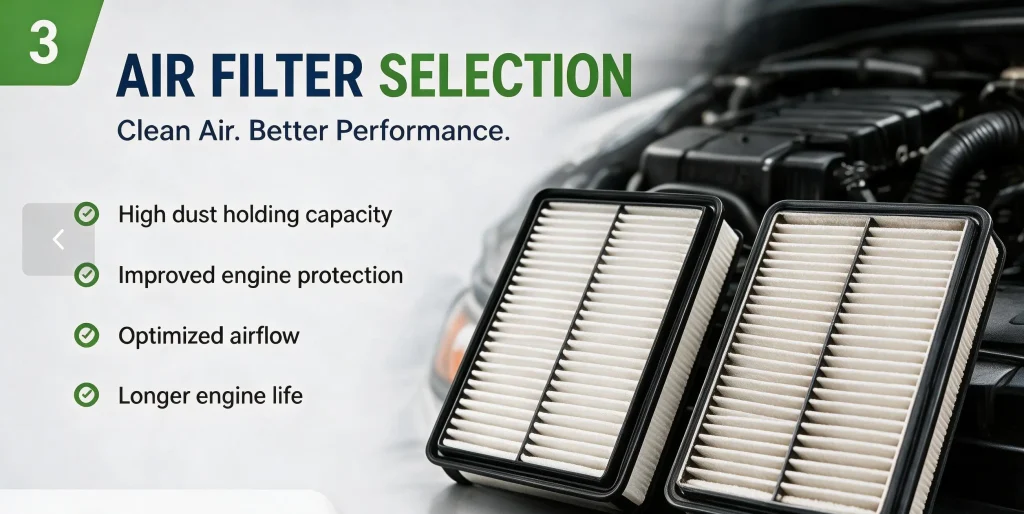
Recommended process:
Step 1: Confirm vehicle make.
Step 2: Confirm model.
Step 3: Confirm production year.
Step 4: Confirm engine type.
Step 5: Check the existing OEM or part number.
Step 6: Compare filter dimensions.
Step 7: Confirm the filter housing and installation design.
Step 8: Verify the aftermarket replacement reference.
For wholesale orders, buyers should also confirm packaging, quantity and product specifications before placing the order.
How to Choose the Right Oil Filter
Oil filter selection requires careful attention to fitment.
A typical identification process is:
Vehicle → Engine → OEM Number → Filter Reference → Dimensions
Important specifications may include:
- Thread
- Gasket
- Diameter
- Height
- Filter design
- Valve configuration
- Application
Do not select an oil filter simply because it has the same external shape as the old filter.
Thread specifications and sealing dimensions can differ.
How to Choose the Right Fuel Filter
Fuel filter selection should consider both the vehicle application and fuel system.
For diesel applications, buyers should pay attention to the filter configuration and any relevant water-separation requirements.
Before ordering, confirm:
- Vehicle
- Engine
- Fuel type
- Existing part number
- OEM reference
- Connection configuration
- Dimensions
For commercial vehicle applications, providing complete information is especially important.
How to Choose the Right Cabin Filte
Cabin filter selection usually involves checking the vehicle application and physical fitment.
The buyer should confirm:
- Vehicle make
- Model
- Year
- Cabin filter reference
- Length
- Width
- Height
- Filter media
- Installation direction
If a carbon cabin filter is required, the buyer should clearly specify this when requesting a quotation.
OEM Number vs. Part Number: What Is the Difference?
This is a common question among automotive parts buyers.
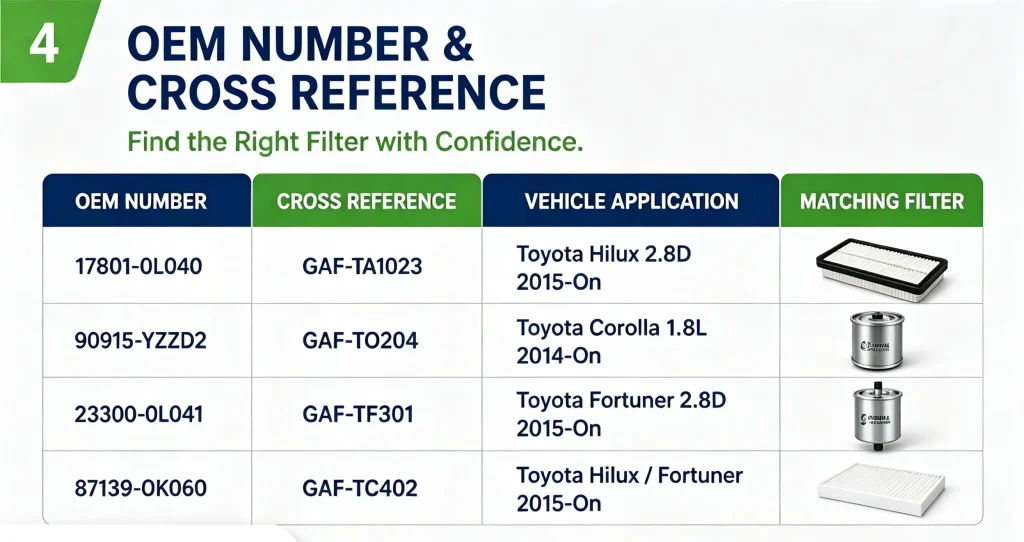
OEM Number
An OEM number is generally associated with an original equipment manufacturer or original equipment application.
Aftermarket Part Number
An aftermarket manufacturer may assign its own part number to an equivalent or compatible replacement product.
For example:
OEM Reference → Aftermarket Brand A → Aftermarket Brand B → Aftermarket Brand C
This is the basic idea behind filter cross-reference.
However, cross-reference information should be verified before confirming compatibility.
What Is Automotive Filter Cross-Reference?
Automotive filter cross-reference is the process of identifying equivalent or compatible filter references between different brands or numbering systems.
A cross-reference may connect:
- OEM number
- Original filter number
- Aftermarket part number
- Supplier reference
- Vehicle application
For B2B buyers, cross-reference can make sourcing more efficient.
Instead of searching for one specific brand, buyers can identify suitable alternatives based on the required application.

Example sourcing process
Existing Part Number
↓
OEM Cross Reference
↓
Vehicle Application Verification
↓
Alternative Filter
↓
Quantity & Specification Confirmation
↓
Wholesale Quotation
This process can help buyers identify products more efficiently.
Common Mistakes When Choosing Automotive Filters
Mistake 1: Choosing by Appearance
Two filters may look almost identical but have different specifications.
Appearance should not be the primary identification method.
Mistake 2: Checking Only Vehicle Brand
Knowing the brand is not enough.
A complete application should normally include the model and engine.
Mistake 3: Ignoring the OEM Number
If an OEM or existing part number is available, it should normally be included in the inquiry.
It can significantly improve the accuracy of cross-reference work.
Mistake 4: Using Dimensions as the Only Reference
Dimensions are useful but not sufficient.
Always combine dimensions with application information whenever possible.
Mistake 5: Assuming One Filter Fits All Engines
The same vehicle model can have multiple engine configurations.
Always verify engine information.
Mistake 6: Ordering in Bulk Without Sample Verification
For large wholesale orders, it can be useful to confirm application and product specifications before committing to the full quantity.
This can help reduce the risk of large-scale compatibility problems.
A Simple Automotive Filter Selection Checklist
Before requesting a quotation, prepare as much of the following information as possible.
| Information | ✓ |
| Vehicle Make | ✓ |
| Vehicle Model | ✓ |
| Production Year | ✓ |
| Engine Type | ✓ |
| Filter Type | ✓ |
| OEM Number | ✓ |
| Existing Part Number | ✓ |
| Filter Dimensions | Helpful |
| Product Photos | Helpful |
| Required Quantity | ✓ |
| Destination Market | Helpful |
The more accurate the information, the easier it is to identify a suitable filter.
Automotive Filter Selection for Wholesale Buyers
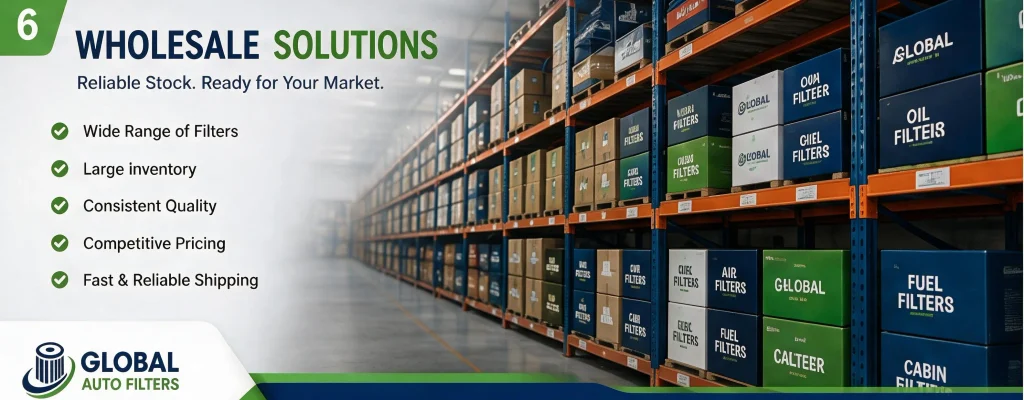
Wholesale buyers have different requirements from individual vehicle owners.
A distributor or importer may need hundreds or thousands of filters across multiple vehicle applications.
In this situation, product selection should consider both fitment and commercial requirements.
Key wholesale considerations include:
Application Coverage
Does the product cover the vehicle models required by your market?
Part Number Accuracy
Are OEM and aftermarket references clearly identified?
Product Consistency
Can the supplier provide consistent specifications across repeat orders?
Quantity
Can the supplier support the required order volume?
Packaging
Is the packaging suitable for distribution and resale?
Shipping
Can the supplier support the destination market and shipping requirements?
Cross Reference
Can alternative part numbers be provided when required?
For distributors and wholesalers, the best filter supplier is not necessarily the supplier with the largest product catalog.
The more important question is whether the supplier can accurately match the right products to the buyer’s applications.
How African Automotive Businesses Can Improve Filter Sourcing
African automotive markets include a wide range of passenger cars, SUVs, pickups, vans and commercial vehicles.
Vehicle fleets can also vary significantly between countries and regions.
For businesses serving these markets, filter sourcing should focus on actual vehicle applications rather than relying only on generic product categories.
Common considerations include:
- Vehicle population
- Popular vehicle models
- Diesel applications
- Commercial vehicles
- Pickup trucks
- SUVs
- Fleet maintenance
- Dusty operating environments
- Replacement demand
- Wholesale availability
For automotive parts distributors and workshops, building a reliable filter reference database can make repeat sourcing much easier.
How to Request an Automotive Filter Quote
When contacting a filter supplier, provide clear product information.
A simple inquiry could include:
Vehicle: Toyota Hilux
Engine: 2.8 Diesel
Filter Type: Air Filter
OEM Number: XXXXXXX
Quantity: 500 pcs
Destination: Africa
Requirement: Wholesale quotation
This is much more effective than simply asking:
“Please quote Toyota filters.”
If the exact vehicle application is unknown, provide an existing filter number or clear product photos.
A supplier can then use the available information for further identification and cross-reference.
Why Part Number-Based Sourcing Is More Efficient
Part-number-based sourcing can reduce unnecessary communication.
Instead of repeatedly describing a filter by appearance, buyers can provide a specific reference.
For example:
OEM Number
→ Search
→ Cross Reference
→ Application Verification
→ Product Matching
→ Quote
This workflow is particularly useful for distributors, importers and workshops handling multiple filter applications.
When Should Automotive Filters Be Replaced?
Replacement intervals depend on the vehicle, filter type, operating conditions and manufacturer recommendations.
There is no universal replacement interval for every automotive filter.
In general, filter maintenance should follow the vehicle manufacturer’s recommended maintenance schedule.
Severe operating conditions may require more frequent inspection or replacement.
Examples include:
- Heavy dust
- Off-road operation
- Commercial fleet use
- Frequent stop-and-go driving
- Poor road conditions
- High-mileage operation
For fleet operators, maintaining service records can help improve replacement planning.
Signs That a Filter May Need Attention
Different filter types can show different symptoms or maintenance requirements.
Air Filter
Possible signs include:
- Excessive dirt accumulation
- Restricted airflow
- Visible filter damage
Oil Filter
The oil filter should normally be replaced according to the engine maintenance schedule and applicable service requirements.
Fuel Filter
Possible concerns may include fuel-system performance issues or visible contamination, depending on the vehicle system.
Cabin Filter
Possible signs include:
- Reduced airflow
- Dust entering the cabin
- Unpleasant odors
- Increased ventilation restriction
These signs are not substitutes for proper vehicle diagnosis, but they can indicate that filter inspection may be appropriate.
How Suppliers Can Help Buyers Find the Right Filter
A professional filter sourcing process should not rely on one piece of information.
A good application-matching process can combine:
Vehicle Information
Make, model, year and engine.
Part Number
OEM number or existing filter reference.
Product Information
Filter type, dimensions and construction.
Cross Reference
Comparison with alternative filter references.
Quantity
Required order volume.
Market
Destination country or region.
Combining these factors creates a more reliable basis for filter sourcing.
Automotive Filter Selection: Quick Reference
| Filter Type | Main Application | Key Identification Factors |
|---|---|---|
| Air Filter | Engine intake air | Vehicle, engine, OEM number, dimensions |
| Oil Filter | Engine oil | Engine, thread, gasket, OEM number |
| Fuel Filter | Fuel system | Engine, fuel type, connections, OEM number |
| Cabin Filter | Passenger cabin air | Vehicle, dimensions, filter type, reference |
This table can be used as a quick reference when preparing a filter inquiry.
Frequently Asked Questions
How do I know which automotive filter fits my vehicle?
Start with the vehicle make, model, year and engine. Then check the OEM number or existing filter part number. Dimensions and photos can provide additional confirmation.
Can I choose a filter based only on dimensions?
It is not recommended. Dimensions are useful for verification, but vehicle application and part-number cross-reference should also be considered.
Is the OEM number the same as the part number?
Not always. An OEM reference and an aftermarket manufacturer’s part number can be different numbers for the same or compatible application.
Can one automotive filter fit multiple vehicles?
Yes. Some filters are used across multiple vehicle applications. However, each application should be verified before confirming compatibility.
What information should I provide when requesting a filter quotation?
Provide the vehicle make, model, year, engine, filter type, OEM or part number and required quantity whenever possible.
Which automotive filter is most important?
All four main filter types serve different purposes. Air, oil, fuel and cabin filters should each be selected according to their specific vehicle application.
How can I source automotive filters for wholesale?
Start by preparing your target vehicle applications and required filter references. Then confirm product specifications, cross-reference information, quantity, packaging and shipping requirements with the supplier.
Can you help with OEM filter cross-reference?
Yes. If you have an OEM number, existing filter reference, vehicle application or product photo, these details can be used as a starting point for filter identification and cross-reference.
Final Checklist: Choose the Right Filter With Confidence
Before ordering an automotive filter, check these seven points:
1. Filter Type
Air, oil, fuel or cabin?
2. Vehicle
Make and model?
3. Engine
Engine type and configuration?
4. Year
Which production year or model generation?
5. Reference
OEM number or existing part number?
6. Specification
Dimensions, construction and filter media?
7. Quantity
How many units are required?
When these details are clearly confirmed, the risk of incorrect filter selection can be significantly reduced.
Need Help Finding the Right Automotive Filter?
Finding the correct filter does not have to start with a product catalog.
If you have an OEM number, aftermarket part number, vehicle model, engine information or existing filter reference, these details can be used to identify a suitable filtration solution.
At Global Auto Filters, we focus on automotive filter sourcing for distributors, wholesalers, spare parts retailers, importers, workshops and automotive businesses.
Our product range includes:
- Air Filters
- Oil Filters
- Fuel Filters
- Cabin Filters
We can support buyers with vehicle application matching, OEM cross-reference and wholesale filter sourcing.
Send Us Your Filter Requirement
Provide your:
Vehicle Model + Engine + Filter Type + OEM/Part Number + Quantity
and request a quotation for your automotive filter requirements.