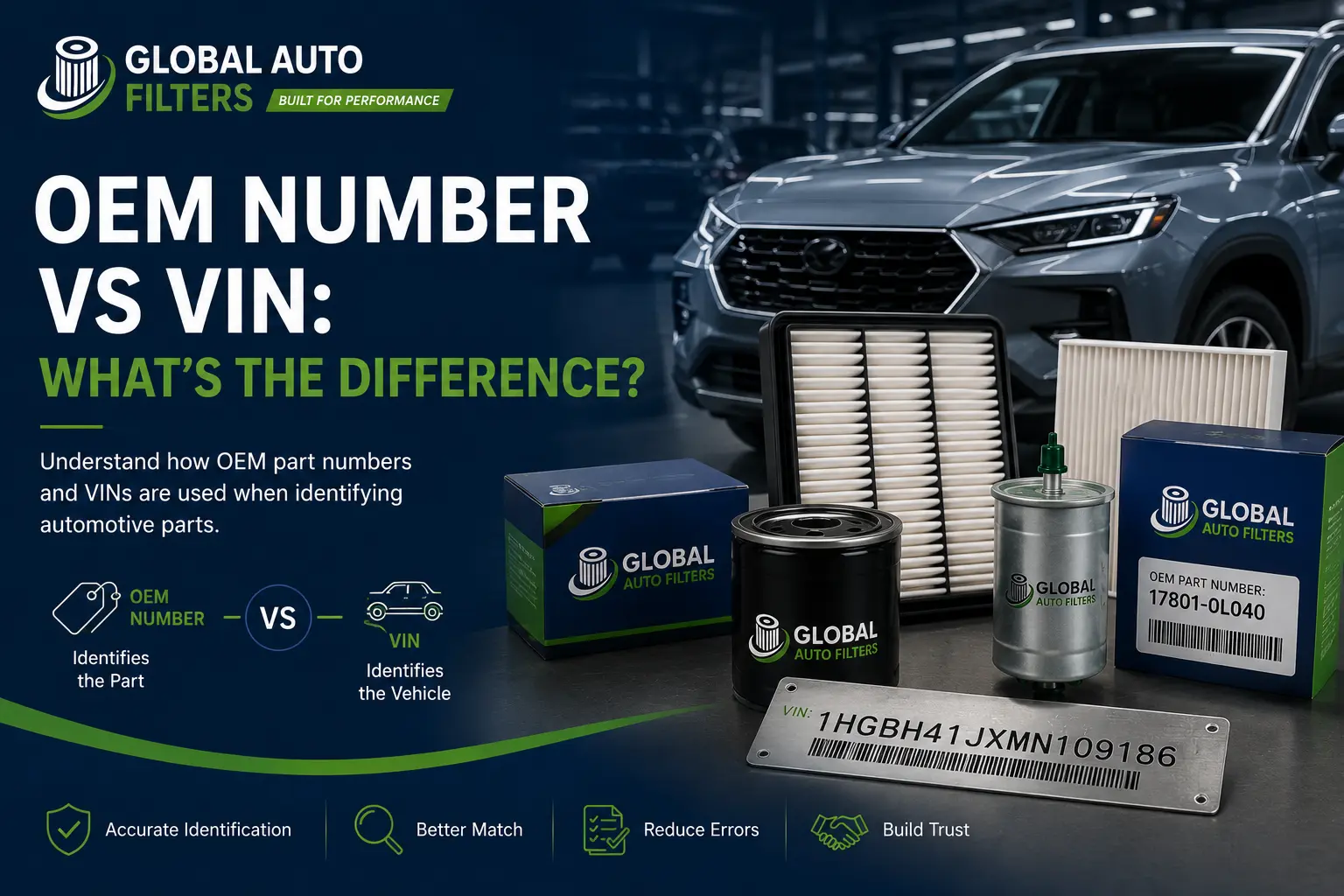
OEM Number vs VIN: What’s the Difference?
Understand how OEM part numbers and VINs are used when identifying automotive parts.
When sourcing automotive filters or replacement parts, buyers often encounter two important references: OEM numbers and VINs.
They are both useful, but they serve different purposes.
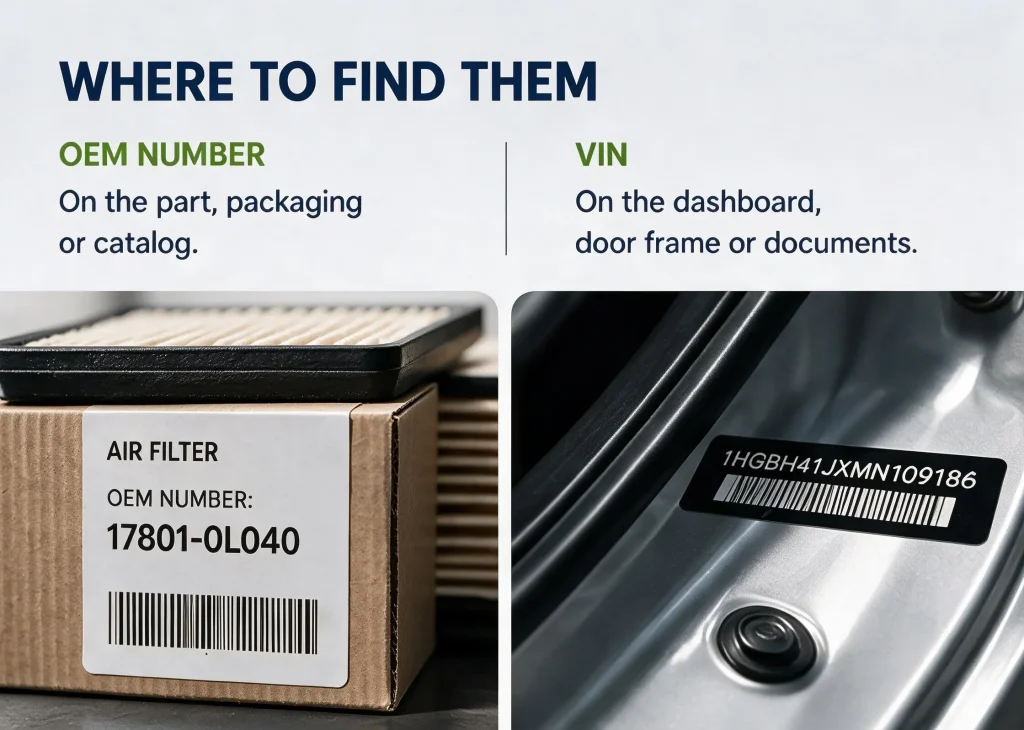
A VIN identifies the vehicle, while an OEM part number identifies a specific vehicle part or component reference.
Understanding the difference can make automotive filter sourcing faster and help reduce incorrect part matching.
What Is a VIN?
VIN stands for Vehicle Identification Number.
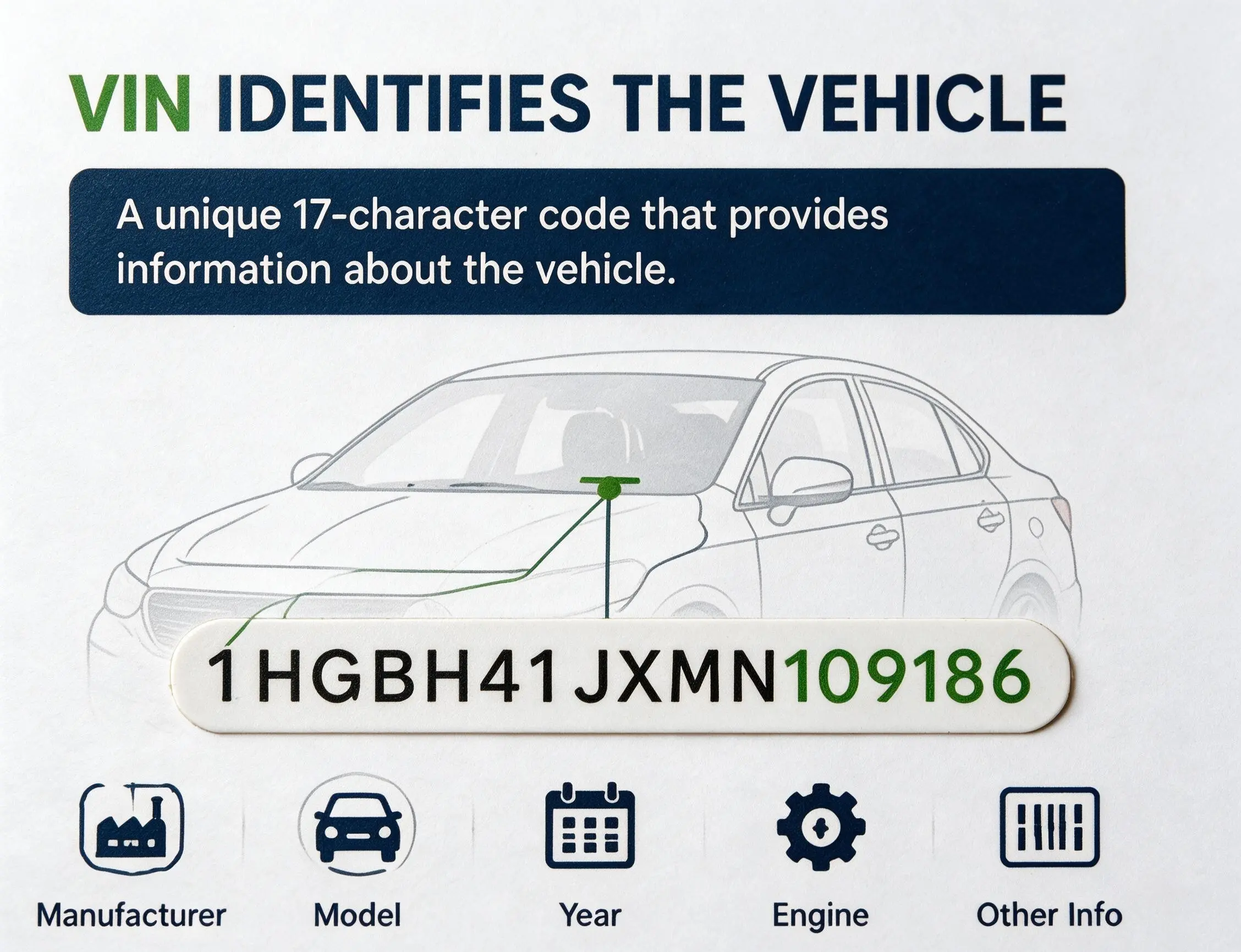
It is a unique identification number assigned to a specific vehicle. A VIN normally contains 17 characters and provides information related to the vehicle’s manufacturer, model, production characteristics and individual vehicle identification.
A VIN can help identify:
- Vehicle manufacturer
- Vehicle model
- Vehicle type
- Production information
- Vehicle configuration
- Individual vehicle
For workshops and vehicle owners, the VIN is useful when the exact vehicle configuration is unclear.
Example
Instead of providing only:
Toyota Hilux
a buyer can provide the VIN to help identify the specific vehicle.
This can be particularly useful when a vehicle model has several engine or production configurations.
What Is an OEM Part Number?
An OEM part number is a reference number used to identify a specific original-equipment part or application.
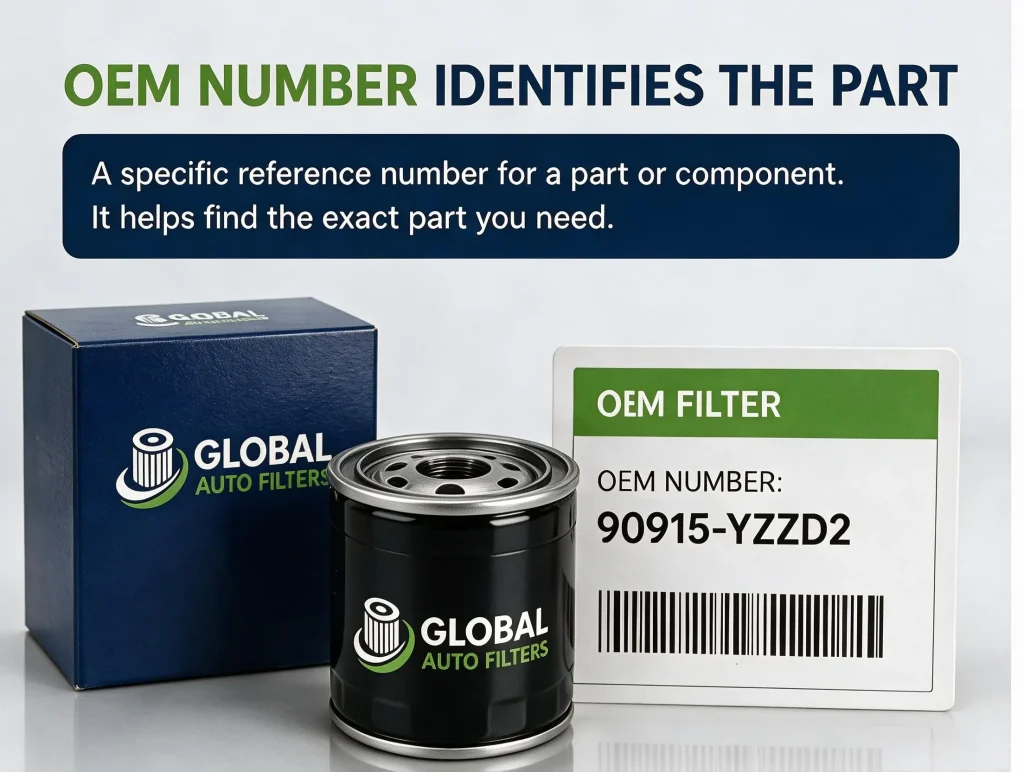
For automotive filters, an OEM number can refer to:
- Air filters
- Oil filters
- Fuel filters
- Cabin filters
- Other replacement components
For example, when looking for an air filter, providing the OEM reference can help a supplier identify the corresponding aftermarket filter.
The OEM number is therefore much more directly related to the part itself.
OEM Number vs VIN
The easiest way to understand the difference is:
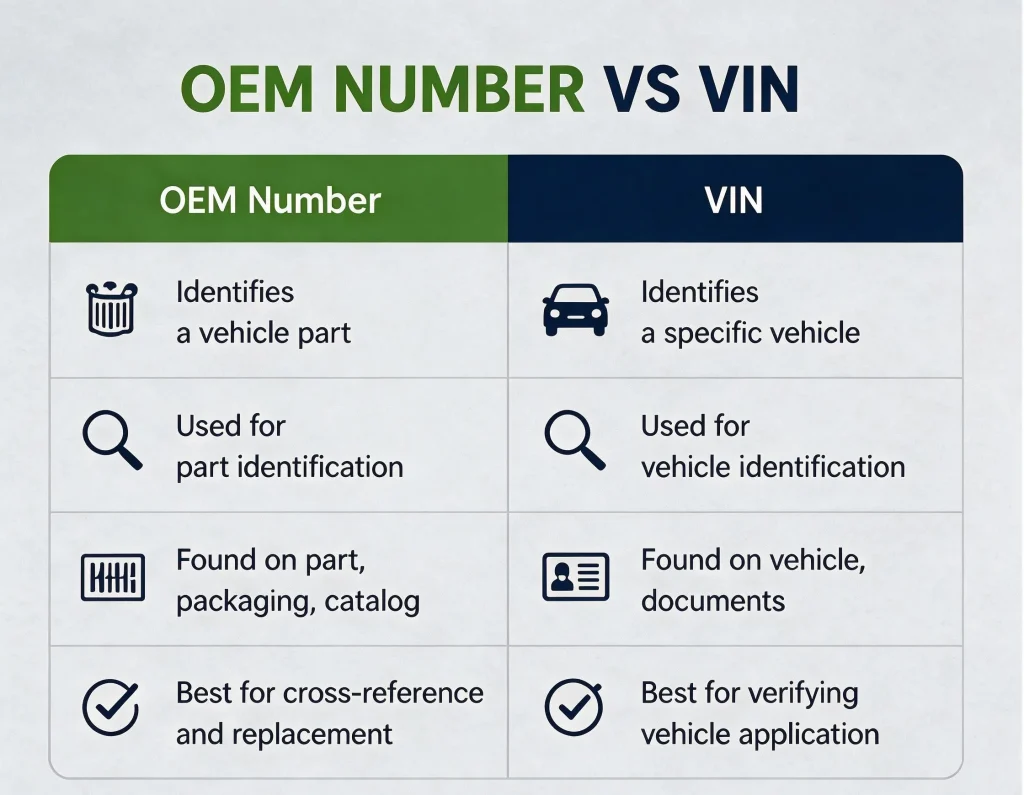
| OEM Number | VIN | |
|---|---|---|
| Identifies | A vehicle part | A specific vehicle |
| Used for | Parts identification | Vehicle identification |
| Usually found on | Part, packaging or catalog | Vehicle/documentation |
| Helps with | Cross-reference | Vehicle application |
| Example | Filter part reference | 17-character vehicle number |
| Best for filter sourcing | Very useful | Useful for application verification |
In simple terms:
VIN = Which vehicle is it?
OEM Number = Which part is it?
Which One Should You Provide When Buying a Filter?
If you already have the OEM number or existing filter part number, this is usually one of the most useful pieces of information for filter sourcing.
For example:
OEM Number: XXXXX
Filter Type: Air Filter
Quantity: 200 pcs
A supplier can use the part reference to investigate possible aftermarket equivalents.
If you do not know the filter part number, provide the vehicle information instead:
Make: Toyota
Model: Hilux
Engine: 2.8 Diesel
Year: 2020
If available, adding the VIN can provide another level of vehicle identification.
Can a VIN Replace an OEM Number?
No.
A VIN identifies the vehicle, not the specific filter.
A single vehicle has many components, including:
- Air filter
- Oil filter
- Fuel filter
- Cabin filter
- Brake components
- Suspension components
- Engine components
The VIN does not directly tell a supplier which filter you want.
For example:
VIN → Vehicle identification → Application research → Correct filter reference
Whereas:
OEM Number → Part identification → Cross-reference → Suitable replacement
Both routes can be useful, but they serve different purposes.
Why OEM Numbers Are Important for Filter Cross-Reference
For distributors, wholesalers and importers, OEM numbers are particularly useful because they can be used as a starting point for automotive filter cross-reference.
A typical sourcing process may look like:
OEM Number
↓
Cross Reference
↓
Vehicle Application
↓
Aftermarket Filter
↓
Quantity Confirmation
↓
Wholesale Quote
This approach can make it easier to compare suitable filter references across different product sources.
When Is a VIN More Useful?
A VIN becomes particularly useful when:
- The vehicle model has multiple engine options
- Production specifications are unclear
- The vehicle year is uncertain
- The buyer does not have the existing filter number
- A workshop needs to identify a specific vehicle
- The vehicle has different configurations within the same model
In these situations, the VIN can help establish the correct vehicle application before selecting the part.
Best Information to Provide a Filter Supplier
For the most accurate filter matching, you do not necessarily need to choose between VIN and OEM number.
Providing several pieces of information is better.
Recommended information:
Vehicle Make
Toyota, Ford, Isuzu, Mitsubishi, etc.
Vehicle Model
Hilux, Ranger, D-Max, L200, etc.
Engine
Engine size or engine code when available.
Year
Production or model year.
OEM Number
Original filter or part reference.
Existing Part Number
The number printed on the current filter.
Filter Type
Air, oil, fuel or cabin filter.
Quantity
Required wholesale quantity.
The more complete the information, the easier it is to verify the application.
For Wholesale Buyers: OEM Number Is Often the Better Starting Point
If you are a distributor, importer, retailer or workshop purchasing automotive filters in bulk, an OEM number or existing part number is often more efficient than providing only a VIN.
For example:
OEM Number: XXXXX
Filter: Oil Filter
Quantity: 500 pcs
This gives the supplier a direct reference for product identification.
If the OEM number is unavailable, then provide:
Vehicle Make + Model + Engine + Year + VIN
This gives the supplier more information to investigate the correct application.
Final Takeaway
The difference is simple:
VIN identifies the vehicle.
OEM number identifies the part.
When sourcing automotive filters, an OEM number or existing filter part number is usually the most direct starting point for cross-reference and replacement identification.
However, vehicle information and VIN details can provide valuable application verification when the exact part number is unknown.
If you are sourcing air filters, oil filters, fuel filters or cabin filters, providing both the vehicle application and available part reference can make the matching process more efficient.
Need Help Identifying a Filter?
Send us your:
OEM Number / Part Number + Vehicle Model + Engine + Quantity
and we can help you identify the appropriate automotive filter for your sourcing requirements.